Friday, 26 February 2016

It's Personal

Technology is an effective tool for communication. This week I shared my learning of Twitter, blogging, TeachMeets and Voxer and how I utilise these platforms to connect with educators. Being connected has many advantages but as a coach, I believe a more authentic trusting relationship is established by connecting on a personal basis.

Emails have so many benefits as you can quickly respond, provide information or seek clarification. A wise women shared that if your email requires more than two small paragraphs, then maybe you should speak in-person with the recipient. If your email consists of a comment, issue or argument that is complex, it may be wise to initiate a conversation either by phone or in person.

I believe corresponding through emails can, at times, slow or even hinder the building of a trusting relationship. We all hear education is built on relationships and how trust is so important. I suppose it comes down to efficiency versus effectiveness. Next time I commence writing an email, I am going to ask myself-could I pick up the phone, walk down the hall, or make the effort to have a personal conversation? If education is built on relationships and trust, shouldn't I respect and value these relationships and make that extra effort?
http://gutsisthekey.com/2014/06/30/increasing-your-appeal/


The questions continue...
@stringer_andrea

Saturday, 13 February 2016

An Adaptable Path

I’ve commenced a new role this year as a Professional Learning Coach and started on my PhD path. I believe in mentoring new teachers and coaching experienced teachers, although I’m beginning to question this more. I’ve experienced being mentored as a beginning teacher in California, which is why I’m so passionate about mentoring. Yesterday, I spoke with my 'assigned' BTSA mentor. Coincidentally, my second mentor (personally chosen) emailed yesterday and although we only speak every 3-6 months, he is always supportive and generous with his time and knowledge. He is a STAR mentor in Seattle Public Schools. Both these relationships demonstrate that once a relationship is established and based on trust, it can endure time and distance and can adapt to suit new goals. I’ve been reading many books and articles about coaching and mentoring and it’s confronting at times for I’ve realised the more I learn, the less I know. A conversation with another coach made me realise that it’s ok to not have all answers. If we did, then where is the learning, the experience, the growth?

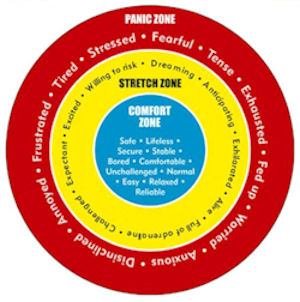
To be honest, I’ve been struggling with this. I’ve also inquired and learnt about the experiences of others at various schools and I was wondering which path to follow-cognitive coaching, instructional coaching, growth coaching etc. During the week I phoned an amazing educator I met at Harvard. It was a 15-minute call, but within those 15 minutes she provided the reassurance and direction I truly needed. Being out of your comfort zone is good but at times, you need support and encouragement. This is coaching! I was being coached as a PhD student. With established trust and good questioning skills, a coach can support you to leap into the stretch zone or retrieve you from the panic zone.

It’s not innovative to follow another’s path but one needs to learn from others and their experiences. How do I create an adaptable path that incorporates all teachers' professional learning needs, while aligning with my beliefs about professional development.

Professional development should be individualised, empowering & sustainable.


Friday, 15 January 2016

Inspired by Words, Inspired by Actions

2016 has begun and already I’ve been kindly invited to present, attend or help organise conferences. A conference is a meeting of people who 'confer' about a topic. I’ve been thinking…What do educators need or want from a conference? By conference, I mean both profit & non-profit. 

* One of my favourite ‘paid ‘conferences I attended last year was the ACEL conference.  http://andreastringer.blogspot.com.au/2015/10/can-you-measure-effectiveness-of.html

* One of my favourite ‘free’ conferences I attended was #TMHouse  https://storify.com/stringer_andrea/tmhouse-november-2015

Inspired by Words
I loved listening to stories shared by Cathy Freeman and Mark Donaldson and the experiences and research presented by the educational keynote speakers was outstanding. I believe keynote speakers can inspire you with their words. They share the latest research or ask questions to clarify or challenge your thinking. They may propose a new approach or idea. It’s up to YOU to follow through with action. Like Twitter, conferences are springboards for you to dive deeper into the topic or connect with the presenter. I do struggle with the ‘sit and listen’ approach and wonder if they could provide time and activities that promote discussion and collaboration with others directly after each presentation. This way you are more likely to transfer words into actions.

Inspired by Actions

A TeachMeet is an organised but informal meeting (in the style of an unconference) for teachers to share good practice, practical innovations and personal insights in teaching with technology. The TeachMeet at Sydney Opera House was inspiring as we listened and viewed effective practises (actions) and stories of learning, experiences and failures. What was different during this TeachMeet was the opportunity to chat. Half way through the presentations, teachers had the opportunity to further speak with the presenters or converse with other educators about what they just heard & viewed. You are provided an opportunity to transfer the actions into words.

I encourage students to ‘turn and talk’ with their peers during my classes, especially when new concepts or skills are introduced. What if conferences encouraged more turn and talk to deepen the level of understanding? Does attending a conference guarantee professional learning? Who is responsible for your PD? What would be your ultimate conference experience?

Providing opportunities to have discussions after presentations enables different perspectives and experiences to be shared and promotes a deeper understanding. 


The learning continues....
@stringer_andrea


Saturday, 19 December 2015

Finding my Purpose

I’m very appreciative and grateful for all the professional events that happened this year and to all those who have supported or provided opportunities.
  • Appointed coordinator of a collaborative K-2 team
  • Accepted into the ‘The art of leadership’ course at Harvard
  • Awarded the Wenona Fellowship that afforded me an amazing learning experience to meet some outstanding educators.
  • Presented at two conferences
  • Travelled to the US to learn from innovative educators, schools, universities, Harvard & ISTE
  • Received the Keith Tronc Award at the ACEL conference
  • Accepted an offer from the University of Wollongong for PhD
I visited JFK museum in Boston 

I attempted to thank many at the end of my blogs through my Gratitude Journal but there are so many to whom I am very grateful. Upon completion of my fellowship, I did some soul searching and spent many hours reflecting on my experiences and incredible opportunities. What is my passion? What do I want to achieve? How can I make a difference? This fellowship was instrumental to my future endeavours.

I recently spoke with an academic who asked me why I was interested in a PhD. Her approach to finding my purpose was a little off-putting and not the supportive manner I’d hoped for. But I'm appreciative because it did make me stop and question why I really wanted to conduct educational research. I have read education texts, articles, blogs and attended conferences and regardless of the topic, the most important thing for me is the 'PURPOSE'.
  • the aim, goal or intention of a person
  • the reason why something is done or used 
  • what a person is trying to do, become, etc.
  • the feeling of being determined to achieve something
So what's my purpose? 
(http://cre8tivefire.com/wp-content/uploads/2015/08/Purpose2.jpg)

This graphic represents 'purpose' and with this wonderful opportunity, I'm conscious of staying focused because I have found I can get easily distracted by being active on social media (Twitter), exploring new apps, reading educational texts, and attending conferences. I know that I'm going to have to lose that Fear Of Missing Out. When I met with my university supervisors, they asked for me to share my story. After listening intently, they asked questions and continually referred back to my comments. They used coaching to clarify my purpose. My purpose is clearer and I know at times I’ll be tempted to venture into other territories, but I will ask myself, 

“Will it support educators and enhance or improve their teaching quality?”

Sunday, 6 December 2015

Yin & Yang

This week I was asked to speak to say goodbye to my colleague. In front of many, I wanted this 2-minute speech to be humorous but also authentic. I spoke with another colleague about how to begin. She commented on what she had heard me say… 'She’s the Yin to my Yang’. While I knew what I meant, I took some time to reflect and wondered how to describe it best. I thought of all the surface differences we have-
  • She’s young and I’m not.
  • She’s petite and well... I’m not.
  • She’s a beginning teacher and I have more experience.
  • She’s more reserved and private and me?…not so much.
This led to me thinking about introverts and extroverts and if you think extroversion relates to how outgoing someone is and introversion is the same as being shy, then that would represent the Yin and Yang I talk about. But there is a misconception about extroverts and introverts. The true meaning is-
  • Introverts (or those of us with introverted tendencies) tend to recharge by spending time alone. They lose energy from being around people for long periods of time, particularly large crowds.
  • Extroverts on the other hand, gain energy from other people. Extroverts actually find their energy is sapped when they spend too much time alone. They recharge by being social.
I read this week that interviews work really well for extroverts and not so much for introverts click here Imagine if a company or school was entirely comprised of extroverts? But I knew our differences were at another or deeper level. And I know what you’re thinking. When you hear differences, you automatically think we don’t get on. You are so wrong!
  
I reflected on a post I wrote at the beginning of the year- “It’s not my work, it’s my passion”. http://andreastringer.blogspot.com.au/2015/02/its-not-my-work-its-my-passion.html Here I blogged about my thinking preferences. After completing the survey, I fell within the red/yellow category and I believe if my colleague completed this survey, she would be green/blue. So what does all this mean?


In essence, my weaknesses or challenges are her strengths. 


The green personality is generally referred to as the calm personality. They don't easily get frazzled and are the essence of calmness even in most stressful situations. Their strengths are-
  • Organised
  • Sequential
  • Planned
  • Detailed
  • Implementer
The blue personality are seen as the perfectionists. They are the ones who would generally examine the smallest details of every situation and fret about each one of them.
Their strengths-
  • Argue Rationally
  • Generalise from specifics
  • Problem-solve logically
  • Critical Analysis 
So I now understand why we need to have various personalities and strengths within organisations. Previously, I thought I worked best with educators 'like me', but this perception has been challenged. Now I believe we need to utilise people’s strengths. Balance appears to be key. Teams could be balanced to work more effectively. Utilising Visible Thinking Routines-

I used to think …that I typically work best with someone ‘like me’.
Now I think… that an effective team requires a balance of personalities.

Through analysing our relationship, I learnt something and I need to thank my wonderful colleague for proving to me that having different personalities works very well. The concept of personalities covers a large gamut and I’ve only observed one element. I'm also thinking that sometimes, you just click with someone and the magic just happens. A colleague no more, but simply my friend.

Always learning,
Andrea

Friday, 20 November 2015

NO GROW ZONE!

At ACEL conference, I had the pleasure of having several thought-provoking conversations with some very well known educators and some…well not so well known. Both were very interesting, rich discussions. And by rich I mean the conversation had me connecting various ideas and concepts; it had me asking questions; it ignited my curiosity. One of the conversations I had really got me thinking… why are some educators so well known, while others not so much? Is it about gender, culture, race, experience (or lack of), having a platform, being connected or having the support of others?

Reflecting on this question, I drew on my own experiences.

I remember one principal sat me down and asked me where did I see myself in five years and what was my passion? She wanted to help me achieve this. This conversation has always stayed with me. She said she believed that someday I would become Dr Stringer. I laughed out loud! The deputy principal shared that she could see me working with beginning teachers one day. I laughed at that comment too! What did they see in me that I couldn’t see? What I do know is that these leaders expressed their belief in my potential. Without me realising it, they were building my self-efficacy and over the years they built my capacity.

In the last few years, I’ve spoken with some educators about doing my PhD. I’ve had various responses. Why would you want to do that? Ah, but you have a husband and three children. Where are you going to find the time? Very rarely did I receive any encouragement...until recently. When I attended Harvard, I was encouraged to ‘Go for it’. The support and encouragement from many (even strangers) was surprising. I was fortunate enough to met Maria there. Maria is a lecturer from Monash University in Melbourne. There are some people who come into your life when you most need them. We connected instantly. She read my blogs and continually encouraged me to pursue my dreams. Just this week, I was fortunate to be invited to #EdCoachRES that provided more support and encouragement. Being surrounded by ‘You can do it’ people really makes a difference. I need to be more like that for others. I need to pay it forward.

So I wonder…Do we support each other enough in education? In Australia, we have the Tall Poppy Syndrome (see below). Does this affect our Australian educational leaders and presenters? Do we promote and encourage our newest teachers to be ambitious, to become leaders, to reach for the stars? Do we model or advise them to play it safe? Do we mentor, support, coach and guide? Do we encourage risk taking? Now change all these questions to 'how'. Asking 'how' generates more reflection. Personally, I want to further develop my ability to support and encourage other teachers, as so many continually support and encourage me.

According to a Chinese friend, they have a similar saying- chū tóu de chuán zǐ xiān làn This means: rafters that jut out rot first. And another: the nail that sticks out gets hammered down. We should encourage our educators to jut out and to support them, so they don't get hammered or cut down. 

And the learning continues...
  
For those who aren’t Australian or familiar with Tall Poppy Syndrome, here's some background information.